If you've noticed your jaw clicking, popping, or grinding — when you chew, when you yawn, when you open your mouth wide — you're not alone. Roughly one in three adults has some kind of audible jaw sound. Most of them never need treatment. Some of them absolutely do. The difference matters more than people think.
This page walks through what jaw clicking actually is, how to tell harmless clicks from clicks that signal a problem, and when it's worth booking an assessment.
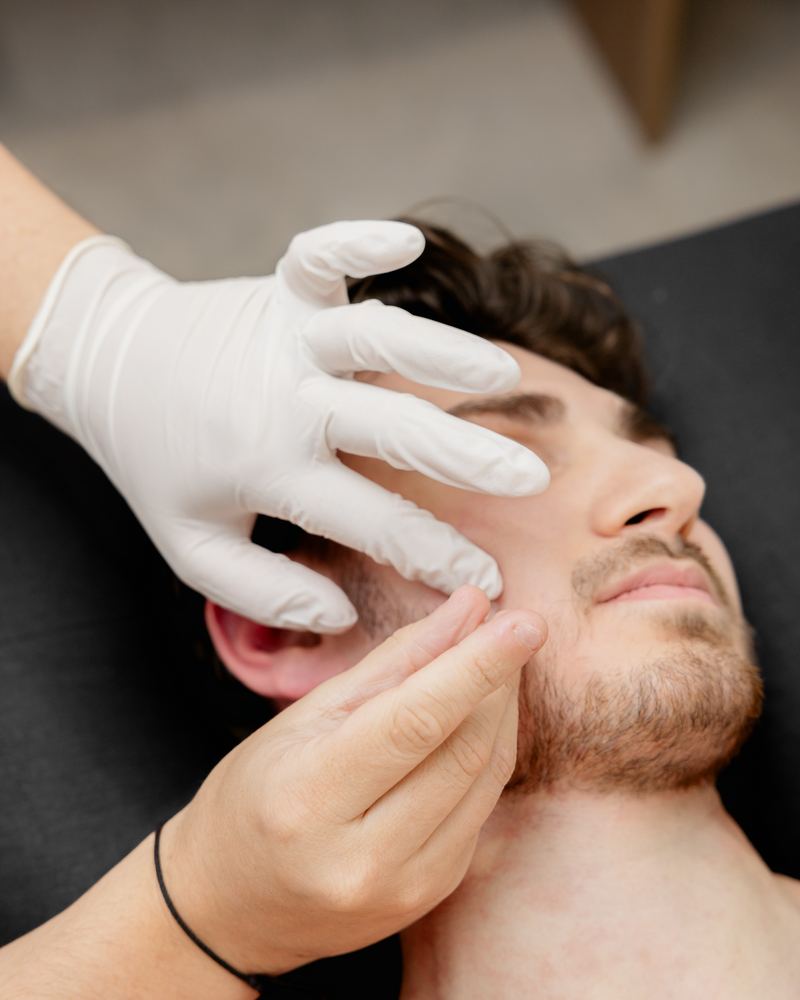
What jaw clicking actually is
The temporomandibular joint has a small disc of cartilage that sits between the bones of your skull and your jaw. The disc moves with the jaw — sliding forward when you open, sliding back when you close. When the disc is sitting where it should and moving smoothly, the joint is silent.
A click happens when the disc gets caught for a moment, then snaps back into place. Sometimes that's because the disc has slipped slightly out of position. Sometimes it's because the muscles around the joint are pulling unevenly. Sometimes the disc itself has a small structural issue. The sound is the same in all three cases — but the underlying cause, and whether it matters, can be very different.
The clicks that don't matter
If your jaw clicks but ticks all of these boxes, it's probably not something you need to chase:
- The click is painless
- It's consistent and predictable — same point in opening or closing, every time
- You can open your mouth fully without restriction
- There's no associated headache, ear pain, or neck pain
- It hasn't changed pattern over months or years
Painless, stable, predictable jaw clicks are usually a benign disc-position quirk. Some people have had them since adolescence. Most never develop symptoms. There's no compelling evidence that treating an asymptomatic click changes long-term outcomes — so chasing it isn't usually worth your time or money.
The clicks that matter
The picture changes when any of these are present:
If any of these are present, the click is part of a bigger picture. Treating the click in isolation rarely works — but treating the joint, the muscles, and the cervical spine together usually does.
A click on its own isn't a diagnosis. A click plus pain plus restricted movement is.
Common causes
1. Disc displacement with reduction
The most common pattern. The disc sits slightly forward of where it should, and the click is the disc snapping back into position as you open. Usually painless if the muscles aren't involved, but can become symptomatic over time.
2. Muscular imbalance
The masseter, temporalis, and lateral pterygoid muscles control the jaw's movement. When one is tighter or stronger than the others, the jaw deviates and tracks unevenly — which can produce a click. Bruxism (teeth grinding) is the most common driver here.
3. Cervical spine restriction
Restriction in the upper neck changes how the jaw tracks. The cervical spine and the jaw share neurology — when the neck is stuck, the jaw rarely moves cleanly. Often missed because the click is in the jaw and the cause is in the neck.
4. Capsulitis or arthritic change
Inflammation of the joint capsule, or early arthritic change, can produce both clicking and grinding sounds. These usually need a proper assessment, often imaging, to confirm.
5. Trauma history
Direct blow to the jaw, whiplash, prolonged dental procedures, intubation. The click can show up months or years after the inciting event.
Why home advice often falls short
The standard advice for jaw clicking — soft food, jaw exercises from YouTube, stress reduction, a soft splint — works for some people. It doesn't work for the cases where the click is part of a bigger pattern, because none of it addresses the cervical spine, the autonomic nervous system, or the muscle-driven asymmetry.
If you've done six weeks of soft food and self-massage and the click hasn't changed, that's useful information: it tells you the click is being driven by something the home routine isn't reaching.
When to see a chiropractor (vs dentist or doctor)
This is where most people get stuck. The honest answer is that the right starting point depends on what else is going on:
- See a dentist first if: the click is accompanied by an obvious bite change, you've had recent dental work that triggered it, or there's suspected joint structural damage that needs imaging coordinated by a dental practitioner.
- See a doctor first if: the click is associated with sudden severe pain, fever, swelling, or follows direct trauma where fracture is possible.
- See a chiropractor with TMJ training if: the click is associated with muscle tightness, headache, neck symptoms, or has been present for weeks-to-months without an obvious dental cause.
For most cases that don't fit the first two categories, an assessment with a TMJ-focused chiropractor is a reasonable first step. If the assessment reveals something dental or medical, you'll get a referral letter on the first visit. That's part of the job.
How treatment works
For symptomatic clicks, the goal isn't always to silence the click — it's to address what's driving it. Treatment typically involves:
- Manual therapy of the jaw and the upper cervical spine
- Dry needling of the masseter, temporalis, and pterygoids when trigger points are present
- High-level laser therapy for the joint capsule when there's an inflammatory component
- Specific exercise prescription to balance the jaw musculature
- Address upstream contributors — bruxism, posture, autonomic component
Most people see meaningful change in 3-6 visits. Some clicks resolve fully. Some persist as a quiet, painless reminder that the joint has had work done — which is fine. The win is when the pain, the locking, the headaches, the limited opening — those go away.