A significant percentage of chronic headache patients have an undiagnosed TMJ component driving their pain — and most don't know it. The trigeminal nerve, the upper cervical spine, and the muscles of mastication share so much neurology that a problem in the jaw routinely shows up as a problem in the head. The patient feels a headache. The cause is upstream.
This page is about how to tell whether your headaches have a jaw component, why this gets missed by GPs and neurologists, and what a proper assessment looks like.
The TMJ-headache connection
The trigeminal nerve is the largest of the cranial nerves. It supplies sensation to the face, the jaw, the TMJ itself, the muscles of mastication, and large parts of the dura mater — the membrane around the brain. The same nerve that tells you your jaw is sore tells you your head hurts.
When the jaw's muscles are overworked — from clenching, grinding, or cervical-driven asymmetric loading — they fire pain signals up the trigeminal pathway. The brain doesn't always localise that signal accurately. What you experience is "a headache." What's actually happening is referred pain from the jaw.
This is well-documented in the literature. The challenge isn't the science — it's that no single profession routinely screens for it.
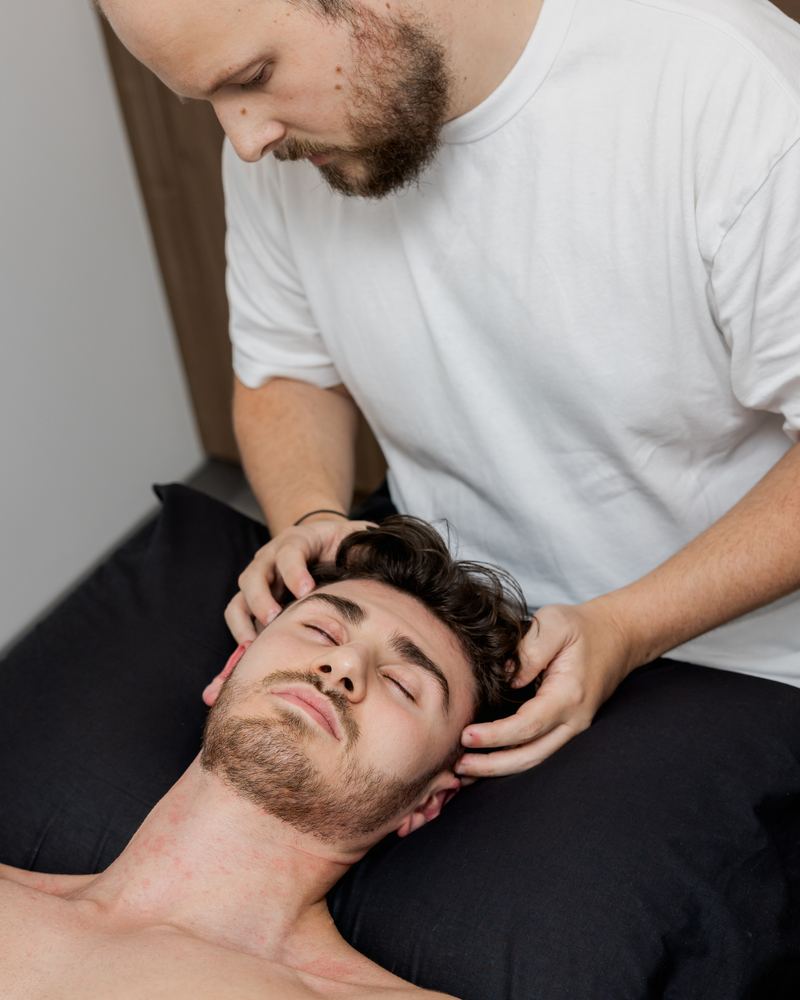
Types of headaches caused by TMJ
Tension-type headaches
By far the most common pattern. The pain is bilateral, band-like, often described as "a tight band" around the head. People with TMJ-driven tension headaches usually wake with them — a giveaway that nighttime clenching is part of the picture. Standard tension-headache treatment (analgesics, posture work) often helps marginally but rarely fully resolves the pattern.
Cervicogenic headaches
Pain that starts at the base of the skull and travels forward. Driven by the upper cervical spine, but the jaw is often involved because the cervical spine and the jaw co-contract during stress. Often unilateral. Often associated with neck stiffness.
Migraine with TMJ trigger
Patients with diagnosed migraine sometimes find their attacks have a jaw trigger — a long meeting where they clenched, a stressful day, a night of poor sleep with bruxism. Treating the TMJ component doesn't cure the migraine but can reduce frequency in patients where the jaw is one of the triggers.
Temporal pain
Pain in the temples specifically. Often the temporalis muscle — one of the muscles of mastication — referring pain into its overlying tissue. Frequently misattributed to "tension" or "stress headaches" when the actual driver is muscle hyperactivity.
Headaches with ear involvement
Headache plus ear fullness, tinnitus, or sensitivity to sound. The TMJ sits directly in front of the ear canal — when the joint is symptomatic, the ear is often along for the ride. ENT exam usually returns "normal" in these cases.
How to tell if your headaches are TMJ-related
None of these alone is diagnostic. Two or three together strongly suggest a jaw component:
- You wake up with headaches, or they're worse first thing in the morning
- The pain feels worse on days you've been clenching, stressed, or slept poorly
- You can reproduce or worsen the headache by clenching your teeth firmly for 30 seconds
- Pressing the masseter (the chunky muscle on the side of your jaw) reproduces some of the pain
- You have other TMJ signs: clicking, jaw soreness, ear fullness, neck tightness
- Your headaches don't fully respond to standard medication, neurology workup, or migraine prophylaxis
- The headaches started or worsened after a period of dental work, whiplash, or significant stress
If most of those sound familiar, your headaches are worth assessing from the jaw end — even if you've been managing them as a "neurology" problem.
A headache patient with a normal MRI, a "tension headache" diagnosis, and a tight jaw is one of the most common presentations I see. The jaw is rarely on the assessment list until someone specifically goes looking for it.
Why this gets missed
It's not that GPs and neurologists are missing something obvious. It's that the assessment doesn't include it. When you present with a headache, the standard workup checks for sinister causes (tumour, stroke, vascular issues), classifies the headache type (tension, migraine, cluster, cervicogenic), and rules out medication overuse. The jaw isn't usually examined unless you specifically mention jaw pain.
Most patients don't volunteer jaw symptoms during a headache consultation because they don't connect the two themselves. They report the head pain. The jaw click, the morning soreness, the occasional ear fullness — those feel like separate, smaller things that aren't worth mentioning to a doctor focused on their headaches.
Which is exactly why a good TMJ assessment includes a headache history, and a good headache assessment should include a TMJ screen — but in practice, very few do.
The cervical spine link
The upper cervical spine — the top three vertebrae and their joints — share neurology with the trigeminal nerve through what's called the trigeminocervical complex. Restriction or irritation in the upper neck can refer pain into the head, the temples, behind the eyes, into the jaw — anywhere the trigeminal supplies.
This is why TMJ-driven headaches and cervicogenic headaches are often the same pattern with different starting points. Treating only the jaw, or only the neck, often produces partial relief. Treating both, in combination, usually produces meaningful change.
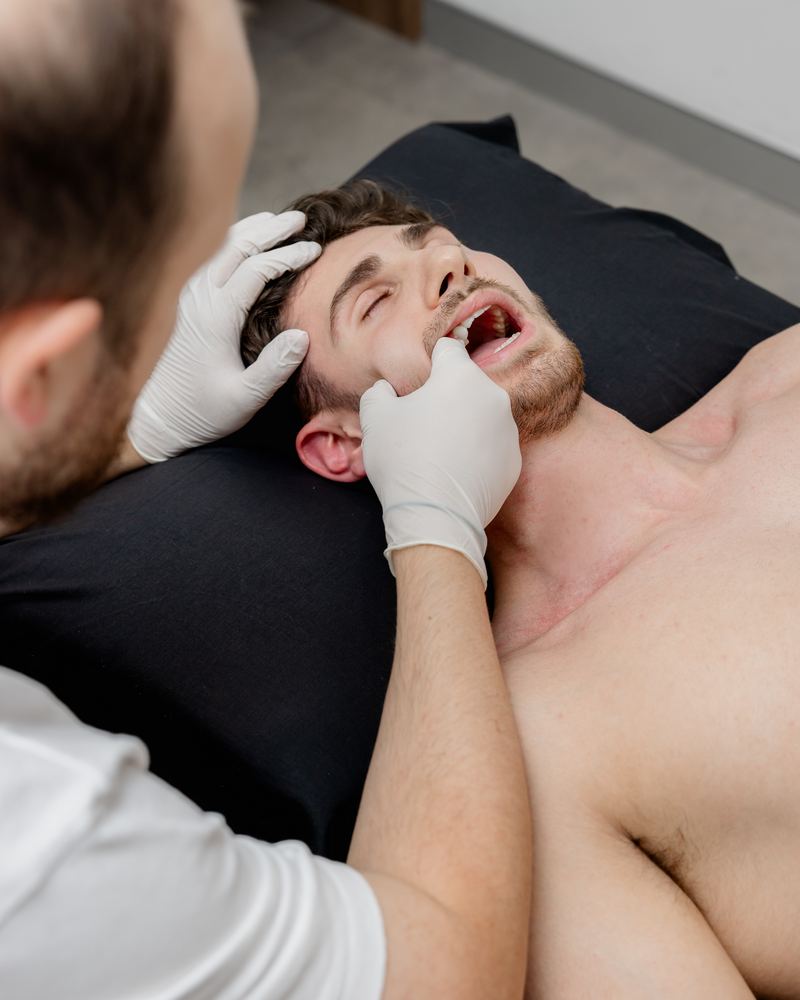
How I assess for TMJ-driven headaches
A first consultation for a headache patient looks slightly different from a straight TMJ presentation:
- Full headache history — pattern, frequency, triggers, what's been tried, response to medication, previous workup (CT, MRI, neurology)
- Sleep and stress history — bruxism (often partner-reported), morning soreness, autonomic symptoms
- Examination of the masseter, temporalis, and pterygoids for trigger points that reproduce the headache pattern
- TMJ assessment — range, tracking, joint sounds, asymmetry
- Upper cervical spine assessment — segmental movement, soft-tissue restriction, palpation reproducing pain
- Screen for red flags — sudden onset, progressive pattern, neurological deficits, systemic features that need urgent referral
If the assessment finds a clear jaw or cervical contribution, treatment proceeds from there. If it finds something that needs neurology, imaging, or a different specialist, you get a referral letter on the first visit.
Treatment approach
For headaches with a confirmed TMJ component, treatment usually combines:
- Manual therapy of the upper cervical spine
- Dry needling of the temporalis and masseter where trigger points are reproducing the headache pattern
- High-level laser therapy for the joint capsule and muscles when there's inflammatory or chronically overloaded tissue
- Specific neurological rehabilitation in cases with a post-concussive or chronic-pain-sensitisation component
- Education and home strategies — sleep position, daytime jaw posture, identifying clenching triggers
Most patients with a clear TMJ-headache component see meaningful change within the first 4-6 sessions. Patients whose headaches have multiple drivers (TMJ plus migraine plus medication overuse) take longer and usually involve coordinating with their neurologist or GP.
What I won't claim
I won't claim chiropractic care fixes every headache. I won't claim every headache patient has a jaw component. I won't claim treating your jaw will eliminate your migraines if you have diagnosed migraine.
What I will say: a non-trivial percentage of chronic headache patients have an unaddressed jaw component, and finding out whether you're one of them takes one consultation. If your case is in scope, we treat it. If it's not, you get a clear answer about who's the right person to see — and a letter that helps the next clinician understand what's already been ruled in or out.